- 2026/09/05
- مقالات خارجی
- نظرات
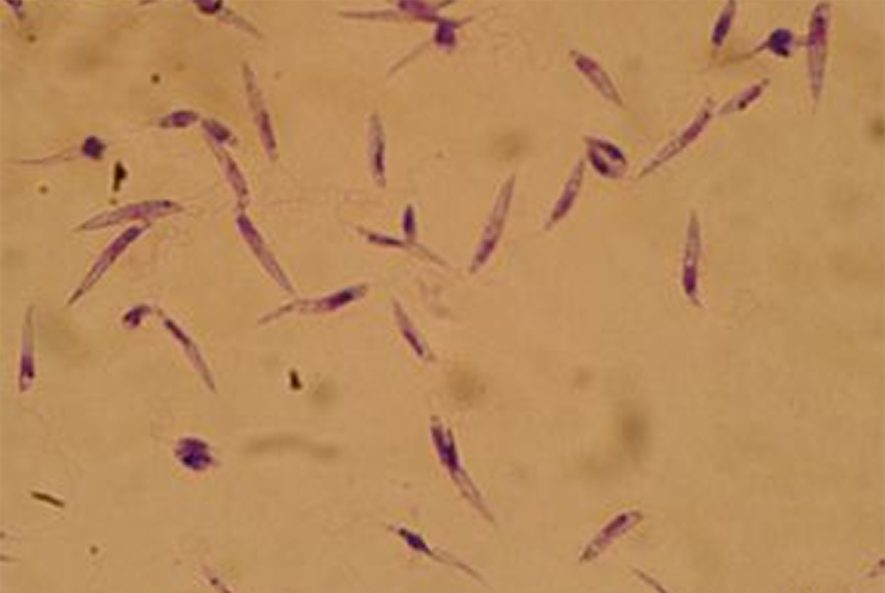
Leishmania major is a species of parasite found in the genus Leishmania, and is associated with the disease zoonotic cutaneous leishmaniasis (also known as Aleppo boil, Baghdad boil, Bay sore, Biskra button, Chiclero ulcer, Delhi boil, Kandahar sore, Lahore sore, Oriental sore, Pian bois, and Uta).[1] L. major is an intracellular pathogen which infects the macrophages and dendritic cells of the immune system.[2] Though Leishmania species are found on every continent aside from Antarctica, Leishmania major is found only in the Eastern Hemisphere, specifically in Northern Africa,[3] the Middle East, Northwestern China, and Northwestern India.[4][5]
Biology
Life cycle
As a trypanosomatid, L. major begins its lifecycle in amastigote form in the midgut of the main vector, female sand flies (Phlebotomus spp.).[6] Once in the gut of the sand fly, the parasites change from aflagelated amastigotes into
flagellated promastigotes for 1–2 weeks until they are fully developed, a which point they make their way to the proboscis.[5] Upon biting a mammalian host, promastigotes are released into the bloodstream, where they are engulfed by macrophages.[7] Following engulfment, promastigotes differentiate into amastigotes.[7] Amastigotes are oval or round, and have a diameter between 2-3μm.[5] Additionally, they contain a large, eccentrically placed nucleus along with a kinetoplast (which holds extracellular DNA).[5] Being equipped to survive the acidic environment inside the phagosomes of macrophages, the amastigotes reproduce through the process of binary fission.[5] At this point the amastigotes are released throughout the body, and can be ingested by female sand flies, thus completing the cycle.[7] L. major has a sexual cycle, including a meiotic process.[8] Mating only occurs in the sand fly vector.[9]
Hosts
Meriones unguiculatus, other Meriones and jirds, and other rodents are common hosts. Dogs,[10][11]: 2 Mustela nivalis,[10] Atelerix algirus,[10] and Paraechinus aethiopicus[10] are rare hosts. Mice are natural hosts.[12] Transmission between mice is via Phlebotomus papatasi.[12]
Infection
Upon entering the mammalian bloodstream, L. major meets the focal point of infection, the macrophage. As a result of two surface molecules, the protease gp63 and a lipophosphoglycan, promastigotes are able to bind to several macrophage receptors.[13][14] Promastigote attachment to macrophages is facilitated by a number of receptors, including complement receptors CR1 and CR3, and the receptor for advanced glycosylation end products.[5] Activation of complements occurs far from the cell membrane, and insertion of the membrane attack complex does not occur.[5] This action is what allows the parasite to avoid being lysed, and to persist within the host’s macrophages. In cattle Th1 and Th2 cells are an important part of the response.[15] Neither cell type expresses exclusively IFNγ or IL-4 for L. major – Brown et al. 1998 find they express both in cattle.[15] The bovine myeloid antimicrobial peptide BMAP-28 has leishmanicidal activity and may be usable in vivo in cattle infection.[16] Lynn et al., 2011 obtain good results against two strains of the parasite, using two isoforms of BMAP-28, the retro-inverso and the D-amino acid.[16]
Enzymatics
Dimethylallyltranstransferase is vital to L. major, making it an interesting target for leishmaniacidal substances.[17] Propenko et al. 2014 present and validate several dimethylallyltranstransferase inhibitors.
Continued Article:
https://en.wikipedia.org/wiki/Leishmania_major