- 2026/06/27
- مقالات خارجی
- نظرات
Abstract
Simple Summary
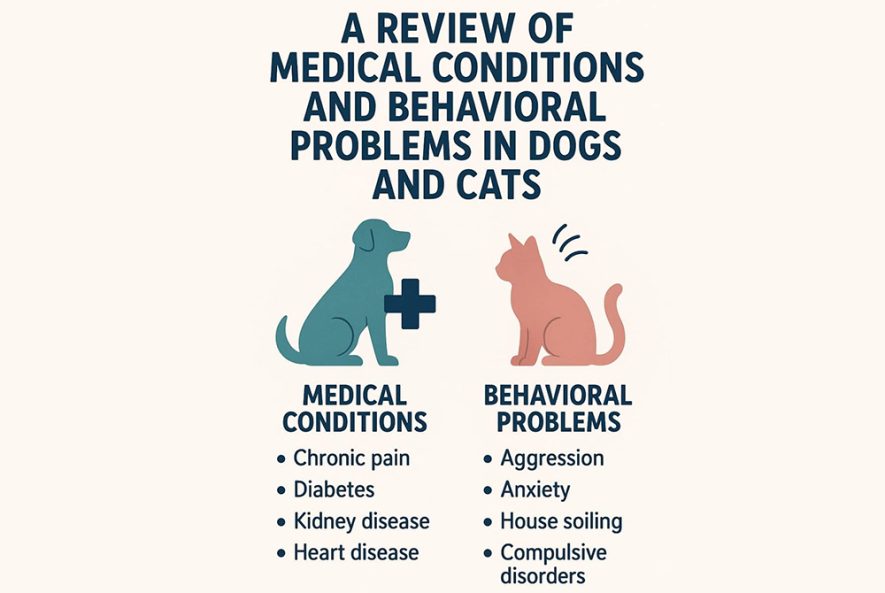
Behavioral problems and medical conditions have been treated separately for years. However, behavior depends directly on an animal’s health condition, and vice versa. Some behavioral problems are caused totally or partially by a medical condition. Additionally, some of these problems represent a diagnostic challenge for veterinarians because, in many cases, apart from behavioral changes, there are no other clinical signs or evidence of illness. Improving our knowledge of the most common medical problems that can modify behavior may help veterinarians to improve their diagnostic protocols and treatments. Based on our experience, most relevant medical conditions are some neurological problems, endocrine or metabolic problems, and pain-related conditions. Thus, the aims of this review are to describe the state of the art of the relationship between these medical conditions (among others) and behavioral problems, and proposing new lines of investigation.
Abstract
Not all animals behave identically when faced with the same situation. These individual differences in the expression of their behavior could be due to many factors, including medical conditions. These medical problems can change behavior directly or indirectly. The aims of this review are to describe the state of the art of the relationship among some medical and behavioral problems, and to propose new lines of investigation. The revision is focused on the relation between behavioral problems and pain, endocrine diseases, neurological problems, vomeronasal organ alterations, and cardiac disorders. These problems represent a diagnostic challenge from a practical point of view. The most common sign of pain in animals is a change in behavior. Although the relation of pain to behavioral problems has been widely studied, it is not absolutely clear. As an example, the relation between sleep disorders and pain is poorly known in veterinary medicine. New studies in humans and laboratory animals show that a reciprocal relationship does, in fact, exist. More specifically, the literature suggests that the temporal effect of sleep deprivation on pain may be stronger than that of pain on sleep. Some behavioral problems could modify the sleep–awake cycle (e.g., cognitive dysfunction). The impact of these behavioral problems on pain perception is completely unknown in dogs and cats. Thyroid hormones play an important role, regarding behavioral control. Both hypothyroidism and hyperthyroidism have been related to behavioral changes. Concerning hypothyroidism, this relationship remains controversial. Nonetheless, new neuro-imaging studies provide objective evidence that brain structure and function are altered in hypothyroid patients, both in laboratory animals and in humans. There are many neurological problems that could potentially change behavior. This paper reviews those neurological problems that could lead to behavioral changes without modifying neurological examination. The most common problems are tumors that affect central nervous system silent zones, mild traumatic brain injury, ischemic attacks, and epilepsy. Most of these diseases and their relationship to behavior are poorly studied in dogs and cats. To better understand the pathophysiology of all of these problems, and their relation to behavioral problems, may change the diagnostic protocol of behavioral problems.
Keywords: behavioral problems, medical conditions, hypothyroidism, sleep disorders, neurological problems
1. Introduction
Not all animals behave identically when faced with the same situation. These individual differences in the expression of their behavior could be due to many factors. Genetics, pre-natal manipulation of the dam [1,2], experiences of the animal during the different developmental stages (especially important, neonatal and socialization periods) [3], experiences during adulthood, and the correct functioning of organs and systems are among these factors.
Medical conditions can modify the proper functioning of organs and systems. Thus, these medical problems can change behavior directly or indirectly. These problems can be divided into four main groups: (1) Problems that modify or prevent the perception of the environment (e.g., blindness), (2) problems that change the processing of the perceived information (e.g., intracranial tumor) or alter the internal processes (hormonal and/or neurological) involved in behavior (e.g., hypothyroidism), (3) problems that induce a stress response that can modify behavior (e.g., pain), and (4) problems that change or prevent the expression of behavior (e.g., a broken leg).
Behavioral problems can be defined in different ways. However, all definitions have at least one or more of the following features. First, behavioral problems are behaviors that must be perceived as annoying by the owners. This fact confers an important degree of subjectivity to the definition and, what is more important, to the recognition of the problem by the owners. Second, they can be dangerous for people, other animals, or even for the patient itself. Third, most behavioral problems, directly or indirectly, can deteriorate the patient’s welfare. Finally, they can appear as a consequence of a medical condition or pathology (i.e., repetitive behavior due to an intracranial tumor) but, also, they can be absolutely normal behaviors that are considered as problematic by the owners (i.e., territorial aggression, competitive aggression, etc.). There are also medical problems that can make a behavioral problem worse (i.e., pain and competitive aggression or partial blindness and fears or phobias). Although the relationship between medical and behavioral problems has been widely investigated, many doubts still exist in that regard. For example, could medical conditions lead to behavioral problems with a “normal and coherent” behavior pattern? Are all behavioral problems, caused by medical conditions, easy to recognize only with the clinical or behavioral history of the animal? Are all of these problems expressed as a change in an animal’s behavior during adulthood, or can the pathology be present from childhood, even when behavioral signs appear when the animal is an adult? All of these questions, among others, are important in order to improve the prevention, diagnostic, and treatment protocols in behavioral medicine.
The aims of this review are to describe the state of the art of the relationship between some medical and behavioral problems, and proposing new lines of investigation.
2. Material and Methods
Problems included in this revision are those that can contribute to behavioral problems, but which are difficult to differentiate from a true behavioral or medical problem. We have included those problems that represent a diagnostic challenge from a practical point of view.
The first review has been performed using Pubmed and Google Scholar. References cited in the articles found in the review have also been taken into account.
3. Pain and Behavioral Problems
The most common sign of pain in animals is a change in behavior [4]. Behavioral signs of pain include both the loss of normal behaviors and the development of new and abnormal behaviors. The most common behaviors classified as “lost normal behaviors” are decreased ambulation or activity, decreased interaction with other pets or family members, lethargic attitude, decreased appetite, and decreased resting behaviors. The most common “developed abnormal behaviors” are aggression, fear reactions, inappropriate elimination, vocalization, altered facial expression, altered posture, restlessness, and hiding [4]. Pain has also been related to repetitive behaviors [5].
From a clinical point of view, pain should be included in the differential diagnoses of aggressive behaviors, fear and phobia reactions, sleep disorders, inappropriate elimination, vocalization, and repetitive behaviors. However, according to the authors’ experience, at least in referral services, pain-related vocalizations are not reported very often as a behavioral problem by the owners
…