- 2026/05/25
- مقالات خارجی
- نظرات
The primary function of the mouth is to obtain and introduce food into the digestive tract. Some of its additional functions include communication and social interaction, grooming, protection, and heat regulation (particularly in dogs). Picking up food, chewing, and swallowing require a complex interaction of the muscles of the jaw, the teeth, the tongue, and the upper throat. When any of these functions becomes compromised through disease or trauma, malnutrition and dehydration may result. A complete oral examination should be a part of your animal’s physical examination, because oral diseases are most effectively treated with early diagnosis. Otherwise, many will remain hidden in the mouth and progress to an advanced stage.
Oral Inflammatory and Ulcerative Diseases
Gum disease ( see Gum Disease), is the most common oral problem in small animals. Other causes for oral inflammatory conditions include immune system disease, chemical agents, infections, trauma, metabolic disease, developmental abnormalities, burns, radiation treatment, and cancer. Infections that have been associated with oral inflammation include canine distemper virus and leptospirosis. Traumatic mouth inflammation may be seen after an animal tries to eat sharp plant material (such as plant awns) or fiberglass insulation. The houseplant Dieffenbachia may cause oral inflammation and sores if chewed. Chronic kidney failure can cause inflammation and sores in the mouth.
Signs vary with the cause and extent of inflammation. Loss of appetite may be seen. Bad breath and drooling are common with mouth inflammation, tongue inflammation, and sore throat. The saliva may be tinged with blood. The animal may paw at its mouth and, due to pain, resent or resist any attempt to examine its mouth. Lymph nodes in the region may be enlarged.
Canine Stomatitis
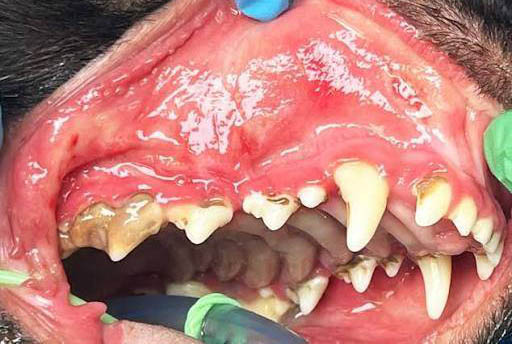
Canine stomatitis involves inflammation of the mucous membranes of the mouth. Signs include severe gum inflammation, receding gums in several sites, and large sores on the mouth surface near the surfaces of large teeth. The problem commonly affects Greyhounds, but it has also been seen in Maltese, Miniature Schnauzers, Labrador Retrievers, and other breeds. The characteristic feature is the contact ulcer or sore that develops where the lip contacts the tooth surface, most commonly on the inner surface of the upper lip next to the upper canine and carnassial teeth (also called the 4th premolar). These abnormalities have also been termed “kissing ulcers” because they are found where the lips “kiss” the teeth. Blood tests and tissue samples can rule out other causes of stomatitis (such as advanced kidney disease).
The cause of this disease is an immune system dysfunction that results in an excessive inflammatory response to dental plaque. For this reason, thorough plaque control through professional cleaning and excellent home oral hygiene (including twice daily tooth brushing) may resolve the problem. Supplemental antibacterial measures, such as topical chlorhexidine rinses or gels, may be prescribed by your veterinarian. In severe cases, topical anti-inflammatory preparations may provide comfort. Discomfort caused by the ulcers can make it difficult to brush your pet’s teeth and give oral medications. If discomfort is severe and you are unable to brush the teeth, extraction of the adjacent teeth may be necessary to remove the contact surfaces on which plaque accumulates. Although extraction may aid in control of the sores, it may not completely cure the problem, as plaque grows on all surfaces in the mouth and animals can continue to develop sores.
Lip Disorders
Lip fold dermatitis is a chronic skin inflammation that occurs in breeds with drooping upper lips and lower lip folds (such as spaniels, English Bulldogs, and Saint Bernards). These lips often accumulate moisture, causing inflammation to develop. The condition may be worsened when poor oral hygiene results in high salivary bacterial counts. The lower lip folds can become very bad-smelling, inflamed, uncomfortable, and swollen.
Treatment of lip fold dermatitis includes clipping the hair, cleaning the folds 1 to 2 times a day with benzoyl peroxide or a mild skin cleanser, and keeping the area dry. Your veterinarian may prescribe a daily application of a topical diaper rash cream. Surgical correction of deep lip folds is a more long-lasting remedy for severe cases.
Lip wounds, resulting from fights or chewing on sharp objects, are common and vary widely in severity. Thorns, grass awns, plant burrs, and fishhooks may embed in the lips and cause severe irritation or wounds. Irritants such as plastic or plant material may produce inflammation of the lips. Lip infections may develop. Wounds of the lips should be cleaned and sutured by your veterinarian, if necessary.
Direct extension of severe gum disease or inflammation inside the mouth can produce inflammation of the lips (cheilitis). Licking areas of bacterial dermatitis or infected wounds may spread the infection to the lips and lip folds. Inflammation of the lips also can be associated with parasitic infections, autoimmune skin diseases, and tumors.
Inflammation of the lips and lip folds can be short- or longterm. Animals may paw, scratch, or rub at their mouth or lip; have a foul odor on the breath; and occasionally salivate excessively or refuse to eat. With chronic infection of the lip margins or folds, the hair in these areas is discolored, moist, and matted with a thick, yellowish or brown, foul-smelling discharge overlying red skin that may have open sores. Sometimes the infection extends from another area of the body; this is easily diagnosed because of the infection that causes it.
Inflammation of the lips that is unrelated to lip folds usually resolves with minimal cleansing, appropriate antibiotics (if a bacterial infection is present), and specific treatment of the cause. Treatment of periodontal disease or mouth inflammation may be necessary to prevent recurrence.
Infectious cheilitis that has spread from a location away from the mouth usually improves with treatment of the primary spot, but treatment of the lip area also is necessary. With severe infection, care includes clipping the hair from the infected area. The area will then be gently cleaned and dried. Antibiotics may be prescribed if the infection is severe or spreads to other locations.
Fungal Stomatitis
Fungal stomatitis is caused by overgrowth of the fungus Candida albicans. It is an uncommon cause of oral inflammation in dogs. Signs include mouth inflammation, bad breath, drooling, refusal to eat, and bleeding or open sores on the tongue or mucous membranes. It is usually thought to be associated with other oral diseases, longterm antibiotic treatment, or a suppressed immune system. In most cases, both the underlying disease and the fungal infection itself will be treated. Follow your veterinarian’s recommendations about diet carefully to support your pet’s recovery. Your veterinarian will also recommend a treatment program to control the fungus causing the problem. This is a critical phase of the treatment because the outlook is poor if the underlying disease cannot be adequately treated or controlled.
Trenchmouth(Necrotizing Ulcerative Gingivitis)
This relatively uncommon disease of dogs is characterized by severe inflammation of the gums (gingivitis), ulceration, and death of the tissue lining the mouth. The cause of this disease is unknown, but it has been suggested that normal mouth bacteria and other microorganisms may cause this disease after some predisposing factor either increases their levels or decreases the mouth’s resistance to infection. Other potential factors are stress, excess use of corticosteroids, and poor nutrition.
The disease first appears as reddening and swelling of the gum edges, which are painful, bleed easily, and may lead to receding gums. Extension to other areas of the inner mouth is common. In severe cases, this results in sores and exposed bone. Bad breath is severe, and the animal may be unwilling to eat due to pain. Excessive drooling may be present, and the saliva may be tinged with blood. The disease is diagnosed by excluding other possible causes.
Treatment generally consists of treatment for gum disease, tooth extractions, professional cleaning of wounds, oral hygiene, antibiotics, and oral antiseptics.
Inflammation of the Tongue
Inflammation of the tongue is called glossitis. It may be due to infection, irritation, wounds, disease, chemicals, or other causes such as electrical burns or insect stings. A thread, string, or other foreign object may get caught under the tongue. Glossitis can also occur in long-haired dogs that use the mouth and tongue in an attempt to remove plant burrs from their coats.
Drooling and a reluctance to eat are common signs, but the cause may go undiscovered unless the mouth is carefully examined. Gum disease may result in reddening, swelling, and occasionally sores on the edge of the tongue. There may be no inflammation of the upper surface of the tongue, but the lower surface may be painful, irritated, and cut by the foreign body. Porcupine quills, plant material, and other foreign materials may become embedded so deeply that they cannot be easily detected. Insect stings can cause sudden swelling of the tongue. Some animals have a tongue with a deep central groove, which often becomes filled with hairs that act as an irritant. In chronic cases of inflammation, a thick, brown, foul-smelling discharge (occasionally with bleeding) may be present. Frequently, the animal is reluctant to allow examination of its mouth.
Glossitis is treated by the veterinarian removing any foreign objects and any broken or diseased teeth. Infection may be treated with an appropriate antibiotic. Cleaning of the wounds and use of antiseptic mouthwashes are beneficial in some cases. A soft diet and intravenous fluids may be necessary. If the animal is weak and unable to eat well for a prolonged period, tube feeding may also be required. Sudden glossitis due to insect stings may require emergency treatment. If the glossitis is caused by another condition, the primary disease will also be treated. The tongue heals rapidly after irritation and infection have been eliminated.